

Hi there, argmin readers! Today brings one of my polarizing football posts. But it is nicely timed with the classes on cost-benefit analysis!
Football season is well underway, and my favorite absurd sports-analytical caricature, Seth Walder, has been tweeting out his hilarious takes. Walder is an ESPN NFL analyst who built a model that he claims can predict the probability of winning a game for every play to three digits of precision.
Though he maintains his sauce must remain secret, Walder claims he can determine the optimal move for any NFL play at any point in any game. His sophisticated model accounts for all aspects of the game, including teams’ strengths, the nuances of route trees, and the fluid dynamics of the air. Apparently, by looking at vast amounts of historical data and using the most cutting-edge probabilistic calculations, he can compute the probability that a team wins given their next play call. On Sundays, he loves to post graphics from his model like this:
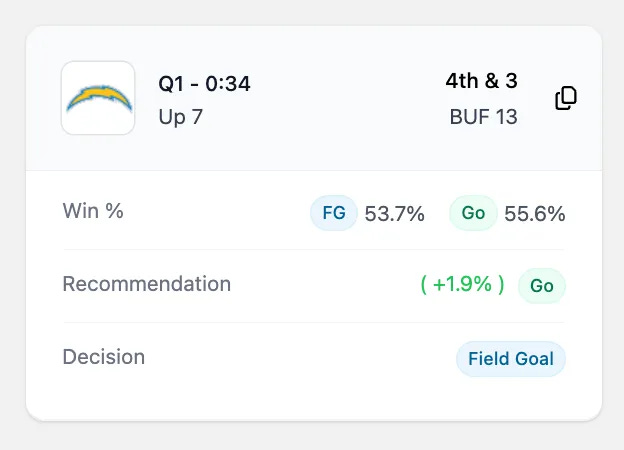
What does this all mean? At the end of the first quarter, the Chargers had the ball on the 13-yard line. It was fourth and three, and they chose to kick a field goal rather than attempt to get a first down in hopes of continuing the drive for a touchdown. Walder’s model said the probability of winning was 53.7% if they kicked the field goal and 55.6% if they attempted the fourth-down conversion.
Where do these precise probabilities come from? He’ll never tell. On Bluesky, a commenter appropriately named “Serious Professional, PhD,” wrote, “In my experience it’s “gotta round somewhere.” Fair enough. I’ve looked into a lot of these probability calculations before, and they always end up being hacky conventions. They are definitely not precise enough to let you accurately judge whether 55.6% or 53.7% in the first quarter accurately translates into anything about winning the game.
Walder, of course, begs to differ: “This is one of those where people say “two-possession lead” when you’re way too early to think that way. It’s about point maximization and kicking, isn’t it.”
I guess he knows best.
Now, look, I’m not going to defend the Chargers, who look to have a total mess of an offense. But it is funny that Walder gets more attention than a random anon account who yells at their screen on Sundays. His cost-benefit analysis is not objective in any way. As we discussed in class, a major part of the cost-benefit framework is transparency so all stakeholders can examine the assumptions that go into computing the ratio of costs to benefits. A secret computer program that argues for maximum aggression at all times doesn’t fit the bill. It’s just a computer program he’s thrown together that says what he wants it to say.
Moreover, I will never get over how analytics people have convinced themselves that they can narrow down the infinite complexity of “going for it” to a single number. The relative complexity of attempting a kick versus running a play is vast. Kicking a field goal is the only play in football without complexity! The snapper snaps it, the holder places the ball on the ground, the kicker kicks. Sure, the field position and weather change the conditions a bit, but compare this to the complexity of what you do when you “go for it” on fourth and three. Do you run or pass? What personnel do you bring in? What route combination do you use? What does the defense do in response? It’s a complex web of decisions that Walder can’t know. But he can tell you the right answer to three digits of precision.
And speaking of the complexity of going for it versus kicking, the Jets did the go-for-2-down-8 thing again on Sunday. This is the third time under Aaron Glenn’s short coaching tenure that the Jets have found themselves down by fourteen points in the fourth quarter. They might want to work on getting leads in the fourth quarter, but that doesn’t seem part of the team’s identity.
Aaron Glenn, who spent four years as an assistant coach under Detroit Lions madman Dan Campbell, has internalized the strategy that maximizes the analytics cost-benefit analysis: score a touchdown to get within 8 and then attempt a two-point conversion. It’s certainly more aggressive, which is why Campbell’s coaching tree loves it.
Indeed, Glenn is one of the three coaches ever to have success with this desperation move. And it almost worked for him this time! He failed the first two-point conversion, but managed to get a second one with the luck of (a) foiling Campbell’s predictable run play on fourth down on the Jets’ 45, (b) driving back 55 yards for a touchdown against the Lions’ pathetic secondary, and (c) throwing a challenge flag the NFL agreed with after the conversion had apparently failed. Of course, the Lions just went and scored another touchdown on the subsequent drive, and the Jets fumbled on their final possession. So it goes.
The Jets are now 4 and 16 under Glenn. They are 1 and 3 when going for two down 8. I suppose you could argue that they are a lot better than last year, but they’ve got a long way to go before they are a good team. But Glenn gets analytics kudos because his losing moves match the model. On the broadcast, announcer Adam Amin declared, “This is an analytically advantageous place to go for two, even if you don’t get it.” Walder of course tweeted out that Glenn had passed the down 8 test. It doesn’t matter if you win. All that matters is that you adhere to the cost-benefit analysis.
I just don’t know how you watch these games and think they are more fun when you ask your computer what the right move is on every down. There’s a market for it. Some people love turning sports into escalating wars of bureaucracy. But we should at least call those people weirdos.