

Hi there, argmin readers! As the fall semester picks up, posting volume will, too. So I’m going to commit to writing short descriptive headers to help you sort through the different threads. Today’s post is a live blog of Lecture 2 of my graduate seminar “Forecasting: A Critical Retrospective.” A table of contents is here.
I’m always looking for how we did science and engineering before the social structures and norms were built up to normalize practice. So for a class on forecasting, let me ask how experts made forecasts before they had proper scoring rules, Bayesian statistics, and Stata.
Though there are plenty of places to start the search, why don’t we today look to the dawn of rationalism in the Enlightenment? Patterns, Predictions, and Actions opens and closes with stories about Edmond Halley. Halley was a master of prediction. He had a keen sense of statistical approximation, knowing how to round and manipulate data to explain the past and predict the future. Halley’s publication record showed a man obsessed with a wide range of forecasting applications.
Halley is best known for his comet, a celestial body that returns to our skies once every 76 years. [footnote: It’s due to return in 2061, but many people’s AGI timelines suggest we won’t be around to see it.] Halley, a strong proponent of Isaac Newton who helped fund the publication of the Principia, wanted to find definitive evidence to prove Newton right.
His proof would come from observations of a comet he had charted in his backyard in 1682. Using Newton’s rules, Halley computed the orbital parameters of the body. He found these parameters neatly matched those of comets observed by Johannes Kepler in 1607. Moreover, they matched those of one seen by German astronomer Petrus Apianus in 1531. Since the gaps between these observations were around 76 years, Halley forecast another observation in 1758. He’d die before its return, but he was right.
This successful celestial prediction is heralded as a crowning achievement of Enlightenment Science. In 1850, Yale astronomer Denison Olmsted, who observed the comet’s return in 1835, wrote, “The Return of Halley’s Comet in exact conformity with the predictions of astronomers established the truth of all those principles by which those predictions were made.” Explaining data we’ve already seen is fine, but there is nothing more convincing to scientists than when theory predicts the future.
The funny thing about this, and a theme we’ll frequently return to this semester, is that this conclusion is completely illogical. It’s a lovely example of affirming the consequent, a fallacy you’ll learn in an introductory logic course.
P implies Q
Q is true
Therefore, P is true.
This syllogism is clearly invalid. (“All the Rationalists live in Berkeley. Ben lives in Berkeley. Therefore, Ben is a Rationalist.” How dare you!) But this is how a lot of science works! Theory predicts a particular outcome. That outcome is observed. This makes scientists feel more convinced their theory is right.
We could go into a long rigmarole about logical positivism at this point, but I don’t want to argue with Bayesian epistemologists today. I just want to point out that even at the inception of the Enlightenment, science was based on the illogic of accurately divining the future. This is one of the things we love about forecasts. When we accurately predict the future, we feel like our internal narrative is true.
Halley’s intuition about forecasting extended far beyond the heavens. He was also a key contributor to modern demography and actuarial science. Protestant pastor Caspar Neumann had collected records of lives, births, and deaths in his hometown of Wroclaw in Poland. Neumann was apparently interested in using this data to disprove the existence of climacterics, where deaths were associated with specific ages like 63. Halley, who came across this data after Leibniz presented it to the Royal Society, had other predictive interests. He churned through Neumann’s data and produced his foundational actuarial life table.
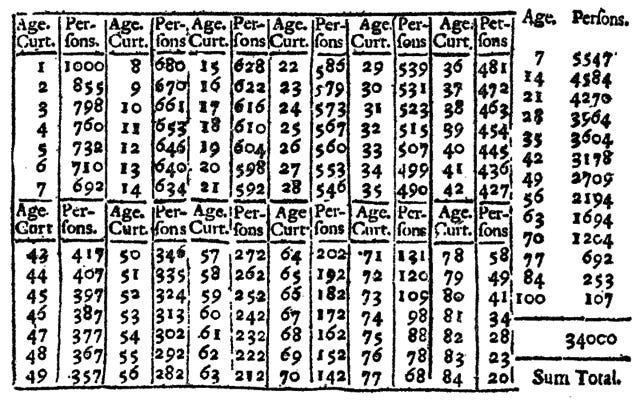
The numbers here represent the counts of people of any given age at a particular snapshot. There were approximately 1000 infants between 0 and 1 (a number, perhaps a bit too convenient), and a total of approximately 34000 individuals in Wroclaw.
In presenting his table to the Royal Society, Halley saw numerous uses for it. He first explained how his table could be used to calculate the number of men draftable into the army. He computed this by counting the number of people aged 18 to 56 and dividing by two.
More relevant to our class, he also pioneered probabilistic forecasting. His second claimed use of the table was calculating the odds that someone might die in a particular time interval. To do this, he counted frequencies and assumed rates of the past were indicative of chance in the future. There were 567 people aged 25, and 560 aged 26. Therefore, the odds a 25-year-old lives to see 26 were 560 to 7 or, simplifying fractions, 80 to 1. Similarly, if you wanted to know the odds that person might live ten years, Halley advocated taking the number alive by age 35, 490, and computing odds: 490 to 77, or approximately 6 to 1.
Halley also used his table to estimate how long people would live by finding the point in a table at which the odds of living dropped below 2 to 1. He called this “The age to which it is an even wager.” Even back in the day before probability, people equated forecasts with fair betting odds.
Not surprisingly, if you could equate mortality forecasts with betting, you could price insurance. This was Halley’s fourth proposed use of his table. Similarly, for a fifth application, Halley worked out more sophisticated calculations and determined a clever scheme to value annuities, a popular means for the crown to raise money. Halley’s calculations set different prices for different ages, based on bets on how long an annuitant might live.
The life table is only one example of Halley’s keen sense that you could make forecasts without physics. Indeed, he seemed to appreciate that the key to forecasting was simply linking past observations with future extrapolations. These extrapolations could be used to confirm physics and create a shared model of reality. They could also guide the pricing of financial instruments wagering on matters of life and death. For Halley, as for us in this class, predicting the future served multiple purposes.
Very interesting. I had not known of Halley's contribution to actuarial science. One minor point: Caspar Neumann lived in Breslau (now Wrocław) which during his lifetime was in the County of Silesia, in the Kingdom of Bohemia, under the rule of the Habsburg Monarchy. His native language was German, but he was also obviously also fluent in Latin.
...& a post-script on the value of forecasting and insurance. Surely one of the most shameful articles that took up two full issues of what became the american economic review was hoffman's article on race traits & the american negro, which `showed,' rigorously that mortality rates were much higher among african americans compared to whites--and that this was a facet of race rather than SES. DuBois was one of the few academics to vociferously object to this.
The article provided exactly the fodder that the insurance companies needed to justify increasing premiums for african americans. From 1875 to 1881, african americans purchased life insurance in large numbers and that collapsed soon after. I (try to) make my students read the entire two volume article, which just seeps of intense scientific racism from the very first page. Megan Wolff has written a wonderful article on this: https://pmc.ncbi.nlm.nih.gov/articles/PMC1497788/
I have always thought of this when I think of what is acceptable in a forecast, and how the forecaster has to play the role of a good new sports statistic, that accords with common wisdom 95% of the time and surprises the other 5.%.....