

This is Part 2 of 7 of a blogged essay “Steampunk Data Science.” A table of contents is here.
Though nutrition science of his time suggested otherwise, Stephen Babcock knew you couldn’t feed cows coal. He would devote his life to finding the best diet for cattle and, in the process, precipitate the discovery of vitamins.
In 1888, Babcock moved to Madison to chair the Department of Agricultural Chemistry at the University of Wisconsin. Agriculture was big business in Wisconsin, and the university was founded as a land-grant institution tasked with emphasizing research and education in agriculture as part of its core academic mission. We all now know Wisconsin as the dairy state, but in the mid-1800s, Wisconsin’s primary export was wheat. However, after seasonal blights and competition from more southernly midwestern states like Iowa, Wisconsin farmers began to shift their emphasis. By the turn of the century, 90% of Wisconsin farms reared dairy cows. By 1915, Wisconsin produced more dairy than any other state in the country.1
This transition to dairy farming was the product of an ambitious public-private partnership between the state’s farmers, government, and university. The university had a mandate to improve the economic and social conditions of Wisconsin. As part of this mission, they established an agricultural research station on the western edge of campus. You can still visit barns and silos. Though it sounds unusual today, the top biologists and chemists in the 1800s devoted major research efforts to improving agriculture.
A particularly important question for farmers was how to feed their livestock. Cows, in particular, are large, hungry animals and are expensive to feed. With the inherently low margins of farming, farmers wanted to spend as little on them as possible. A central research theme in 1800s Agricultural Chemistry was finding the least expensive diet that produced healthy, large cows that gave delicious milk and bore healthy offspring.
When Babcock arrived in Wisconsin, modern nutrition theory was in its infancy. Protein had been discovered in 1838, and most nutritionists understood that it was essential to a healthy diet. As often happens after a revolutionary discovery, the conventional advice from scientific experts focused too strongly on their newly discovered nutrient. Wilbur Atwater had devised a method to determine the available protein and caloric energy in foods based on nitrogen content. From this, nutritional guidelines were proposed to maximize protein at the cheapest price possible.
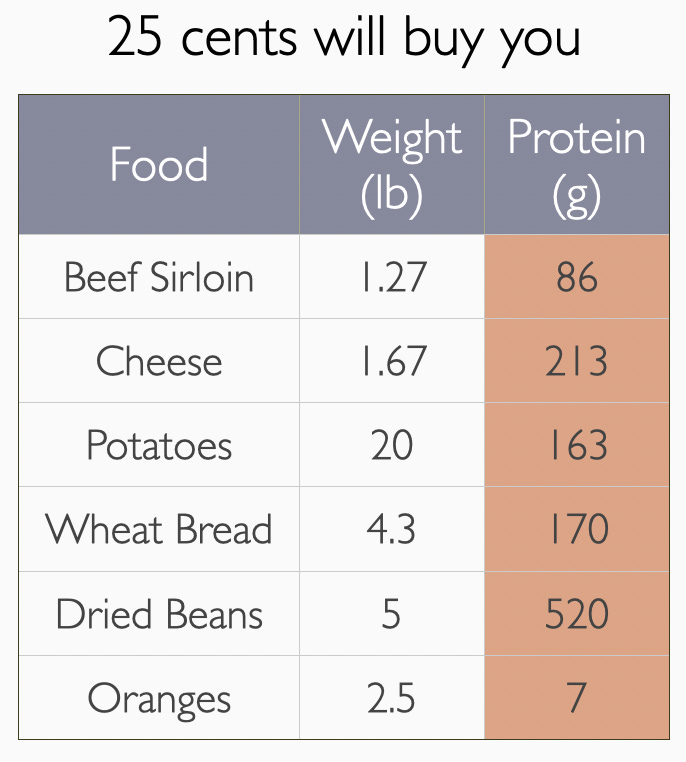
You couldn’t buy big tubs of whey isolate in 1887, and the table above lists some potential alternatives for the protein-conscious. Each quantity of food could be purchased for 25 cents in 1887 dollars.2 If price and protein were the only concerns and intestinal distress could be dismissed, a person would eat nothing but beans.
Having grown up on a farm himself, Babcock knew this conventional wisdom was suspect. He would ridicule Atwater and his colleagues, asking why we didn’t just feed cows dung or soft coal, as both cleared the bar for available energy and nitrogen content.
Farmers’ intuitions about feed suggested value in variety when it came to feeding cows. Babcock figured they must do this for a reason. Although these grains had similar macronutrients, no single grain would be sufficient for healthy animals. What would happen if cows were only fed single grains? If cows were only fed wheat, or only corn, or only barley, balanced so the protein and mineral content were the same, would this still yield thriving cattle?
Babcock pressured his dean to allow him to run an experiment. He proposed purchasing some young calves, raising them on single feeds, and comparing their development. The university had ample resources to tend and manage the cows, and Babcock would oversee the scientific reporting.
The dean balked. Such an interdisciplinary project would be nothing but a headache. He’d have to marshal support from the Animal Husbandry department, and they were demanding resources for their pet-breeding projects. Cows were expensive! Couldn’t Babcock pursue research on food chemistry without raising his own animals?
Though disappointed, Babcock found he could succeed in the lab without animals. In the next few years, he devised simple tests that would revolutionize dairy farming. His most famous discovery was a simple procedure to test the fat content of milk. This test could be done by civilians and allowed people to determine whether impurities had been added to the milk to dilute it or if someone had skimmed cream off the top. Moreover, farmers could use Babcock’s test to select cows that produced higher fat milk for breeding. In addition to his innovations, Babcock was an engaging, committed teacher and held forums with farmers to discuss best practices and current challenges. By 1900, Babcock had become a Wisconsin celebrity. He was a fixture in both the academic and farming circles across the state.3
Despite his extraordinary academic success and impact, Babcock never gave up on his single-grain experiment. He finally got his way in 1907 upon his retirement. Babcock was succeeded by Edwin Hart, who loved Babcock’s research proposal. Hart marshaled the resources for the experiment.
The university purchased 16 cows that were divided into four groups. Each of the groups of cows was fed a special diet. The first group was only fed corn, the second group only wheat, the third group only oats, and the fourth group an equal combination of the three grains. They then waited to see what would happen.
My first job as a professor was at the University of Wisconsin, and that’s also part of why I was so drawn to this story. They named streets after Babcock! If you don’t have the pleasure of visiting Madison, you can read more on the history of the economy of Wisconsin and the public-private partnership with the university in
John D Buenker. (2013). The History of Wisconsin, Volume IV: The Progressive Era, 1893-1914, volume 4. Wisconsin Historical Society.
This table was originally assembled by Atwater and printed in the Century Magazine, one of the most popular magazines of the late 1800s. For more on these early developments in nutrition, see
Kenneth J Carpenter. (2003). A short history of nutritional science: part 2 (1885–1912). The Journal of Nutrition, 133(4):975–984. https://jn.nutrition.org/article/S00223166(22)15713-5/fulltext.
My biography of Babcock is pieced together from recollections of his collaborators. In particular:
Edwin Bret Hart. (1949). Stephen Moulton Babcock. The Journal of Nutrition, 37(1):1–7. doi:10.1093/jn/37.1.1.
Elmer Verner McCollum. (1964). From Kansas Farm Boy to Scientist: The Autobiography of Elmer Verner McCollum. University of Kansas Press.
Harry L. Russell, Glenn Frank, and A. S. Alexander. (1943). Stephen Moulton Babcock, man of science: a memorial to him in observance of the centenary of his birth. Wisconsin Alumni Research Foundation. https://digital.library.wisc.edu/1711. dl/FPJBPAWEVQOFZ87.